
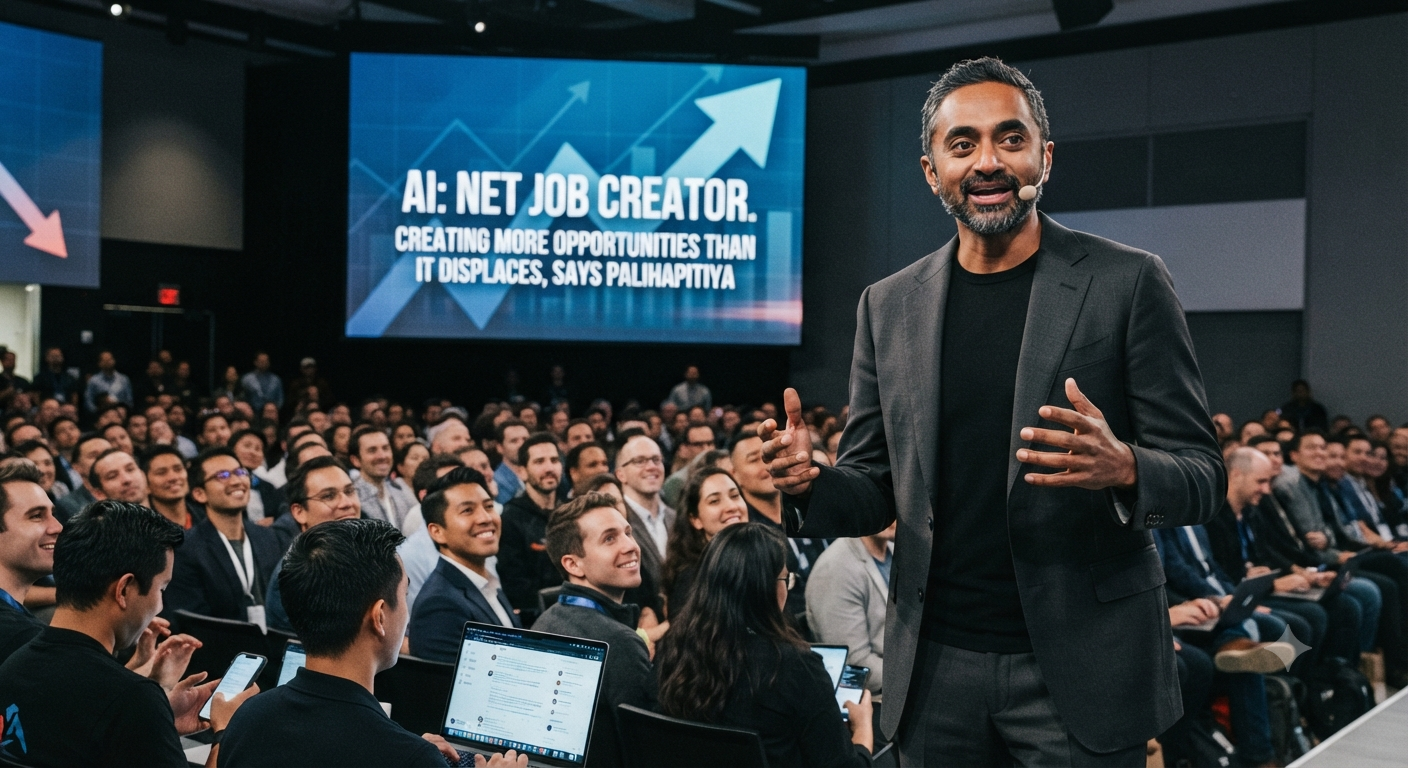
As the global economy grapples with the rapid integration of artificial intelligence, a central debate has dominated boardrooms, legislative chambers, and dinner tables alike: Will AI be the ultimate engine of prosperity, or the catalyst for unprecedented displacement? Amidst the fear-mongering and technical pessimism, investor and venture capitalist Chamath Palihapitiya has emerged as a leading voice of optimism, arguing that the AI revolution will ultimately generate far more opportunities than it displaces.
The Philosophical Shift: From Efficiency to Creation
At the heart of Palihapitiya’s thesis is a fundamental reassessment of what AI actually provides to the modern enterprise. While much of the early public discussion focused on the potential for AI to automate routine tasks—thereby leading to concerns about job loss—Palihapitiya suggests that this narrow view misses the bigger picture.
He argues that the true power of AI lies in its ability to democratize access to high-level expertise and drastically lower the “cost of creation.” By making complex software development, data analysis, and creative output accessible to a wider range of individuals, AI is effectively acting as a force multiplier for human intent.
Democratizing Innovation
For Palihapitiya, the primary beneficiary of the AI era is not just the large tech conglomerate, but the individual entrepreneur. When a single individual, armed with AI tools, can perform the work that previously required a team of ten, the barrier to entry for building a business drops to near zero.
- This shift inherently favors the creation of new startups and niche businesses that were previously economically unfeasible.
- It allows for the rapid scaling of ideas, enabling small teams to compete on a global stage against legacy incumbents.
- By reducing the “friction of creation,” AI fosters an environment where innovation is limited only by imagination, rather than resources or capital.
Addressing the Displacement Myth
While Palihapitiya acknowledges that specific job roles will inevitably be disrupted, he views this as a historical constant rather than a novel catastrophe. He draws parallels to previous technological leaps, such as the introduction of the personal computer and the rise of the internet. In those instances, while certain administrative and labor-heavy roles vanished, they were replaced by entirely new categories of employment—roles that were impossible to conceive of before the underlying technology matured.
The Net-Positive Workforce
Palihapitiya’s stance is that the “displacement” narrative is fundamentally flawed because it assumes a static labor market. He asserts that:
- The economy is dynamic, and as AI improves productivity, it creates new wealth and consumer demand that, in turn, requires new forms of human labor to service.
- The transition toward AI-augmented roles will prioritize human skills that cannot be easily codified—specifically empathy, strategic high-level oversight, and nuanced ethical judgment.
- We are moving toward a future where human work shifts from “doing the task” to “orchestrating the system,” which inherently requires a larger, more sophisticated workforce to manage the AI-driven output.
The Role of Capital and Infrastructure
Palihapitiya’s optimism is also grounded in the massive capital expenditure (capex) cycle currently fueling the AI boom. He notes that the buildout of physical infrastructure—ranging from data centers and power grids to semiconductor manufacturing—is creating a massive ripple effect in the global economy.
This investment cycle is not just about training models; it is about building the foundation of a new industrial age. This infrastructure requires physical labor, logistical coordination, energy management, and specialized engineering, all of which are providing a strong baseline for economic growth independent of the software-centric AI gains.
A Vision of Abundance
Perhaps the most compelling part of Palihapitiya’s outlook is his belief that AI will fundamentally change the cost structure of essential services. By increasing productivity in sectors like healthcare, education, and energy, AI could significantly lower the cost of living.
If the cost of accessing high-quality medical diagnostics or personalized education drops due to AI intervention, the “real income” of the average worker increases, even if their nominal wages remain stable. This deflationary pressure on essential costs, paired with the new economic opportunities generated by AI-enabled startups, creates the conditions for a society defined by abundance rather than scarcity.
Conclusion: The Path Forward
Chamath Palihapitiya’s message is ultimately one of empowerment. He recognizes the friction of the current transition, but he warns against the dangers of reactionary regulation that might stifle the productivity gains promised by this technology.
By viewing AI as a tool for human enhancement rather than a replacement for human agency, Palihapitiya suggests that we are at the beginning of a period of immense growth. While the landscape of work will undoubtedly look different in a decade, the core of his argument remains unchanged: the human desire to build, create, and solve problems will find new, vastly more powerful mediums through which to express itself. For those willing to adapt, the AI-driven future promises to be one of unprecedented opportunity.









Leave a Reply