
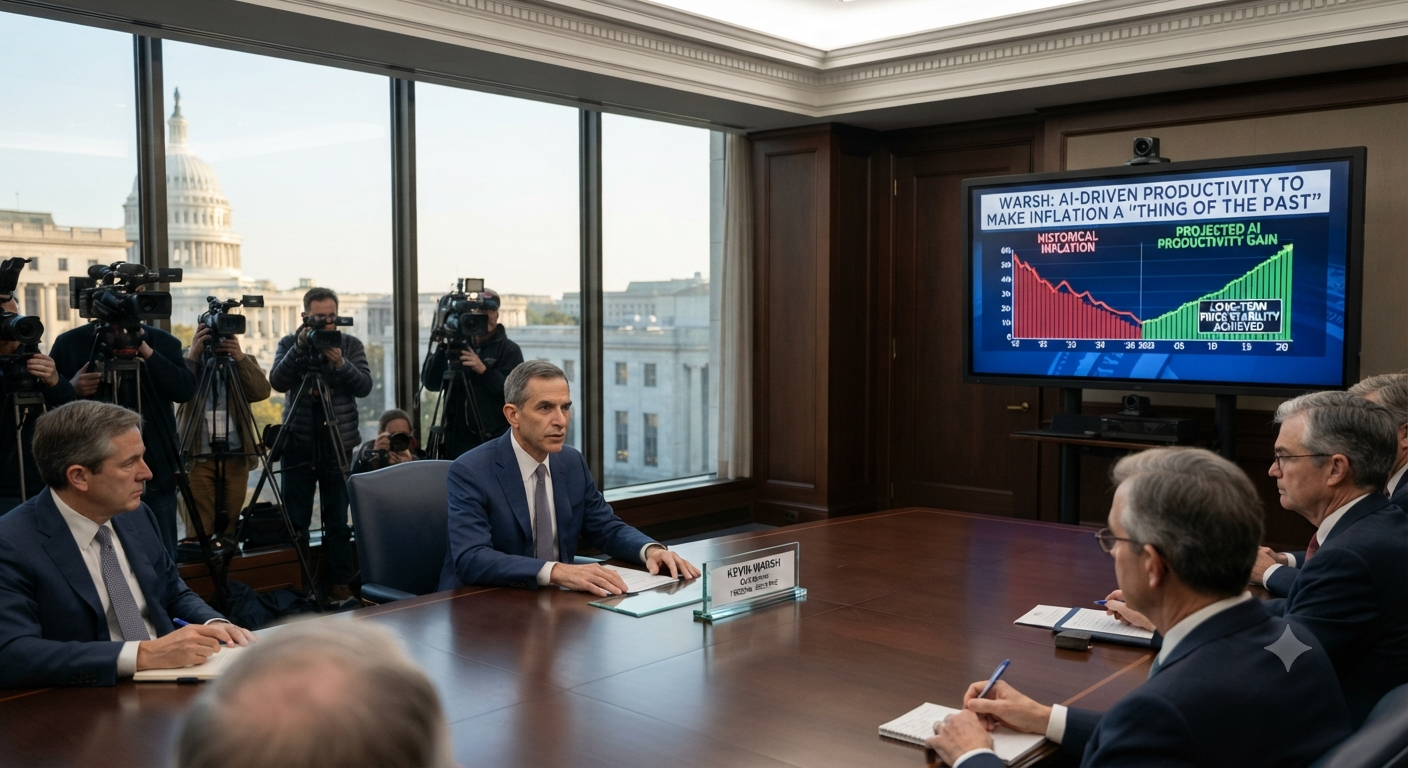
In the evolving landscape of 2026, the Federal Reserve finds itself at a critical crossroads. Under the new leadership of Chair Kevin Warsh, the central bank is navigating a complex economic environment characterized by persistent inflationary pressures, geopolitical volatility—most notably the conflict involving Iran—and the rapid, transformative integration of artificial intelligence (AI) into the U.S. economy. As of July 14, 2026, Chair Warsh has articulated a clear, unwavering stance: the Federal Reserve has “no tolerance” for high inflation, and the recent surge in prices will ultimately be relegated to a “thing of the past”.
The Warsh Doctrine: A New Framework
Chair Warsh’s arrival at the helm of the Federal Open Market Committee (FOMC) has signaled a definitive shift in communication and monetary policy strategy. Departing from the last two decades of “forward guidance,” which prioritized giving the market hints about future interest rate paths, Warsh has opted for a more direct, fact-based approach.
In his recent congressional testimony, Warsh emphasized that the Fed’s primary objective is to maintain price stability, steering the economy by focusing on empirical data rather than speculative long-term projections. By removing explicit future guidance and eschewing tools like the “dot plot,” the new leadership aims to reclaim the Fed’s flexibility and prevent the central bank from becoming “overly talkative,” which Warsh argues can distort financial prices and limit the institution’s responsiveness.
AI: An Infrastructure Cycle or a Disinflationary Force?
A cornerstone of Warsh’s economic philosophy is the role of artificial intelligence. While critics and proponents alike debate the timing and magnitude of AI’s impact, Warsh views it through a dual lens.
1. The Short-Term Inflationary Pressure
In the immediate term, Warsh and other experts recognize that the AI buildout is not inherently costless. The massive scale of investment required—encompassing data centers, semiconductors, power grid upgrades, copper, cooling systems, and specialized labor—creates significant demand-side pressure. This “infrastructure cycle” can be inflationary, as evidenced by rising prices in sectors like electricity and hardware. Warsh acknowledges that these new opportunities introduce fresh challenges for policymakers, noting that the Fed is actively monitoring the implications of this buildout on both inflation and labor markets.
2. The Long-Term Productivity Boom
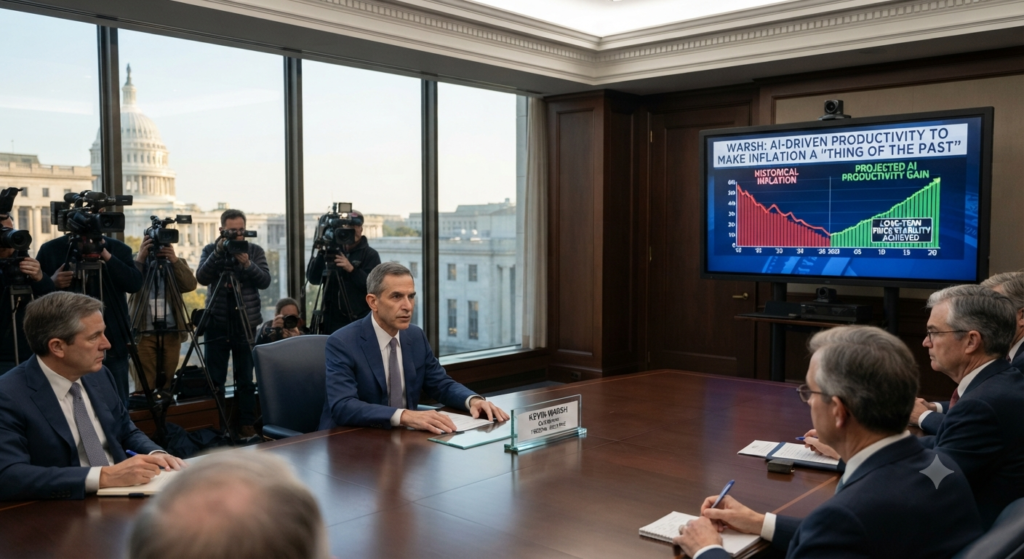
Despite short-term headwinds, Warsh maintains a bullish outlook on the long-term potential of AI to enhance efficiency. He posits that as the infrastructure matures, AI-driven productivity gains will become a powerful disinflationary force. By reducing production costs and increasing the economy’s overall output, AI could fundamentally alter the equilibrium rate of interest, theoretically allowing for a more stable, non-inflationary growth environment.
Challenges and Critical Perspectives
The reliance on AI productivity as a cornerstone of monetary policy is not without its detractors. Critics from institutions like the Cato Institute argue that anchoring policy on a “forecast dressed as a framework” poses risks. Because credible estimates for AI’s productivity impact range widely—from negligible annual gains to more significant double-digit impacts—some analysts worry that the Fed might be lured into premature rate cuts based on speculative future productivity that has yet to fully manifest.
Furthermore, the “Warsh doctrine” faces the immediate reality of an economy buffeted by external shocks. The conflict in the Strait of Hormuz and the impact of global tariffs continue to influence energy prices and trade dynamics, creating a “noise” that the Fed must filter out to reach its underlying inflation goals. Warsh has indicated a preference for “trimmed mean” inflation metrics, which exclude extreme price swings to provide a clearer reading of trends than traditional measures.
The Path Ahead: Policy Amid Uncertainty
As of the June 2026 meeting, the FOMC held the federal funds rate steady at 3.50%–3.75%, reflecting a cautious approach. Warsh’s strategy is defined by:
- Data-Driven Decision Making: Moving away from long-term guidance to a meeting-by-meeting assessment of economic realities.
- Structural Focus: Prioritizing business investment and productivity as the engines of long-term stability.
- Commitment to Price Stability: Reiterating that the Fed has “no tolerance” for persistent inflation, effectively signaling that rate cuts will not be rushed simply on the hope of future AI efficiency.
Whether AI will ultimately serve as the “silver bullet” for inflation remains one of the defining economic questions of the decade. For now, Kevin Warsh is steering the Federal Reserve toward a future where the central bank is a vigilant, data-reliant institution, one that is optimistic about technological progress but remains acutely aware of the short-term pressures that currently weigh on American households and businesses. The coming months will test whether this new communication framework—and the underlying belief in AI’s transformative power—can successfully tame the inflation of the last five years and restore long-term price stability.






Leave a Reply